

Square Enix has given Nintendo Switch 2 owners plenty of reasons to be excited. Major role-playing games are appearing on the new hardware, older releases are receiving technically improved editions, and the company’s wider multiplatform strategy is bringing more of its catalogue to Nintendo players.
Unfortunately, the way Square Enix is handling some of those upgrades has created an increasingly difficult problem for existing customers.
Several games already available on the original Nintendo Switch are being reissued as separate Switch 2 products without a free update, discounted upgrade pack or compatible save transfer. Players who already purchased these games can continue using the older versions through backward compatibility, but anyone who wants the native Switch 2 improvements must buy the game again and begin a new save file.
That approach is the focus of growing criticism surrounding Square Enix’s Switch 2 strategy. The problem is not that enhanced versions cost money. It is that the company repeatedly offers no reasonable path between the version players already own and the supposedly definitive edition arriving on newer hardware.
Final Fantasy X/X-2 Demonstrates the Problem
The Switch 2 edition of Final Fantasy X/X-2 HD Remaster arrived on July 23, 2026, bringing Tidus and Yuna’s adventures to Nintendo’s latest system.
The newer release provides a sharper presentation, improved textures and quality-of-life options previously unavailable in the original Switch edition. These additions include tools that can accelerate gameplay, disable random encounters and reduce some of the time required for grinding. However, the collection reportedly remains limited to 30 frames per second.
Those improvements make the Switch 2 release the better Nintendo version for someone experiencing the games for the first time. Existing owners face a much less appealing decision.
Nintendo’s official store page explicitly states that Square Enix has no plans to sell an upgrade pack for the original Switch edition. It also confirms that save data cannot be transferred between the Switch and Switch 2 versions.
A player who already owns the 2019 Switch release must therefore purchase the entire collection again to receive the enhancements. Any progress from the older version—including completed story chapters, character development and optional endgame activities—must be left behind.
The issue is particularly noticeable because the Switch 2 edition does not substantially rebuild either game. It enhances an existing remaster of two PlayStation 2 RPGs while adding several convenient features. Those additions could reasonably support a modestly priced upgrade, but asking returning players to pay for another complete copy is far more difficult to justify.
The Same Policy Is Spreading Across Square Enix’s Catalogue
Final Fantasy X/X-2 is not an isolated case.
Square Enix is also preparing a native Switch 2 edition of Dragon Quest XI S: Echoes of an Elusive Age – Definitive Edition. The new version will offer separate performance and quality modes, including a 1080p option targeting 60 frames per second and a 1440p mode targeting 30 frames per second.
Once again, however, owners of the original Switch release will not receive an upgrade option. Nintendo’s product page says there are no plans for an upgrade pack and that saves from the Switch version are incompatible with the Switch 2 edition.
This is especially punishing for a game like Dragon Quest XI S. Completing its main story and optional content can require an enormous investment of time. Even players willing to repurchase the RPG for smoother performance may be discouraged when doing so means abandoning an established party and restarting the adventure.
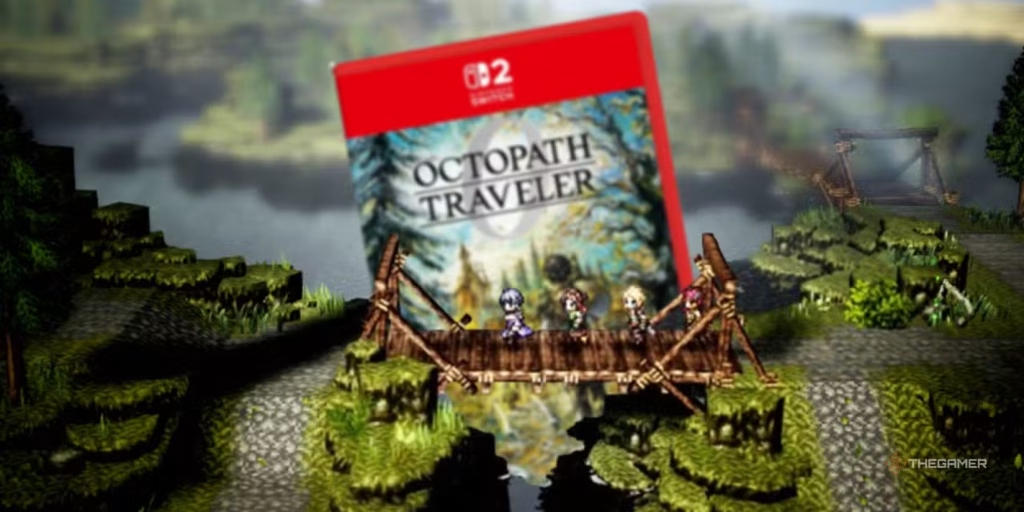
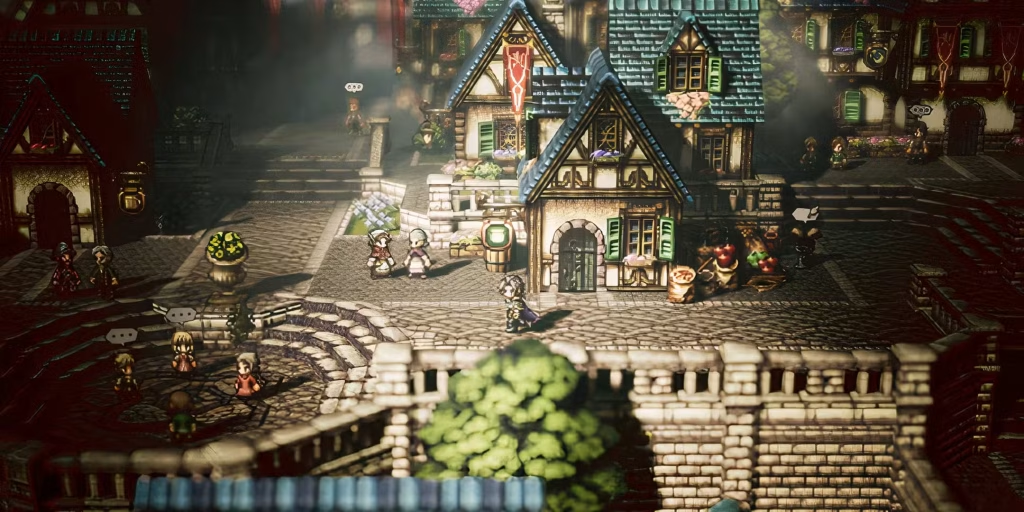
The first two Octopath Traveler games will receive similar Switch 2 releases on October 1, 2026. The native editions promise improved resolution and frame rates, with both games targeting 60 frames per second instead of the original Switch versions’ 30-frame target.
Square Enix is again treating them as separate purchases. Nintendo’s listings for both games confirm that no upgrade packs are planned and that save data cannot move between the two console versions.
That means someone who supported the original Octopath Traveler when it debuted on Switch in 2018 receives no ownership discount for the improved edition. The same applies to players who purchased Octopath Traveler II on Nintendo’s first-generation system in 2023.
Backward Compatibility Is Not an Upgrade
Defenders of this strategy may point out that Switch owners are not losing access to anything they purchased. The older editions remain playable on Switch 2 through backward compatibility, so nobody is technically forced to buy the newer versions.
That is true, but it does not address the central complaint.
Backward compatibility allows players to run the old software. It does not provide the higher resolutions, improved frame rates or newly added convenience features included with the native releases. Anyone seeking those benefits is still being asked to purchase substantially the same game again.
The distinction matters because Nintendo Switch 2 already supports an official upgrade-pack system. Publishers can offer free or paid packages that add graphical improvements, additional features or new modes to an existing Switch game.
A paid upgrade would therefore be a reasonable compromise. Square Enix could charge returning customers for the work involved in optimizing each title without demanding the price of another complete copy.
Instead, its current approach treats longtime owners exactly like first-time buyers while also denying them the ability to preserve their progress.
Incompatible Saves Make the Policy Worse
The absence of an upgrade discount is frustrating, but the loss of save compatibility may be the more damaging decision.
Role-playing games are built around long-term progress. Players spend dozens—or sometimes hundreds—of hours developing characters, collecting equipment, completing side quests and unlocking optional content.
Restarting a short action game after moving to new hardware may be inconvenient. Restarting Dragon Quest XI S, Final Fantasy X or either Octopath Traveler can mean repeating an extensive campaign before reaching the content a player actually wants to revisit.
Save transfers would also make purchasing the new editions more attractive. A returning player could continue an unfinished adventure while benefiting from the improved performance. Without that option, the newer release becomes less of an upgrade and more of a replacement that erases the practical value of the earlier investment.
Technical differences can occasionally make cross-version saves difficult to support. However, Square Enix has not provided a detailed public explanation for why the saves are incompatible across so many of these reissues.
Fans Are Not Demanding Everything for Free
The criticism does not depend on the belief that every Switch 2 enhancement should be given away.
Porting and optimizing older games requires development work. Higher resolutions, improved frame rates, revised textures and additional quality-of-life tools all have costs attached to them. A reasonably priced upgrade pack could acknowledge that work while also recognizing that an existing customer has already paid for the underlying game.
Nintendo’s upgrade framework provides room for both free and paid approaches. The problem with Square Enix’s policy is that it skips this middle ground entirely.
For many players, a small upgrade fee would be acceptable. Paying the full price again—sometimes while losing a lengthy save file—is far less consumer-friendly.
The inconsistent treatment also creates confusion. Customers must inspect each product page to determine whether a particular game supports an upgrade, whether saves can be transferred and whether the Switch 2 release is an enhanced version or an entirely separate product.
Clearer and more consistent rules would make future Square Enix releases easier to understand before customers place their orders.
Square Enix Risks Discouraging Its Most Dedicated Audience
The players most affected by this strategy are not newcomers. They are the people who already purchased Square Enix’s games, sometimes at launch, and supported franchises such as Octopath Traveler during their earliest years on Nintendo hardware.
These customers are also among the people most likely to purchase improved editions. They already enjoy the games and may be interested in replaying them with smoother performance or better visuals.
Requiring them to pay again without offering save transfers turns that enthusiasm into a disadvantage. The more loyal the customer, the greater the chance that they already own the version Square Enix now expects them to replace.
It is also a poor fit for the publisher’s increasingly aggressive multiplatform direction. Bringing more games to more systems should make Square Enix’s catalogue easier to access. Complicated ownership rules and repeated full-price purchases create the opposite impression.
A Better Strategy Is Already Available
Square Enix does not need to abandon native Switch 2 releases. The enhanced editions clearly offer technical advantages, and new players deserve access to the strongest versions available on Nintendo hardware.
The company simply needs to treat previous customers more fairly.
A stronger policy would provide a free or modestly priced upgrade whenever a corresponding Switch edition already exists. Save transfers should be supported wherever technically possible, and any incompatibility should be explained clearly before preorders begin.
Players who do not own the original could still purchase the full Switch 2 product. Existing owners would pay only for the improvements rather than purchasing the base game for a second time.
Until Square Enix adopts such an approach, every new Switch 2 re-release risks generating more frustration than excitement. Better resolution and smoother performance are welcome, but they should not require loyal RPG fans to repeatedly empty their wallets—and erase their adventures—to experience them.


Comments
Share your opinion and keep the conversation respectful.