

Spoiler Warning: This review discusses developments from all 12 episodes of KILL BLUE Season 1.
A legendary assassin trapped inside the body of a middle school student sounds like the foundation for a violent action comedy. KILL BLUE, however, is at its best when its protagonist puts away his weapons, joins an after-school club and discovers that ordinary school life may offer something his first childhood never did.
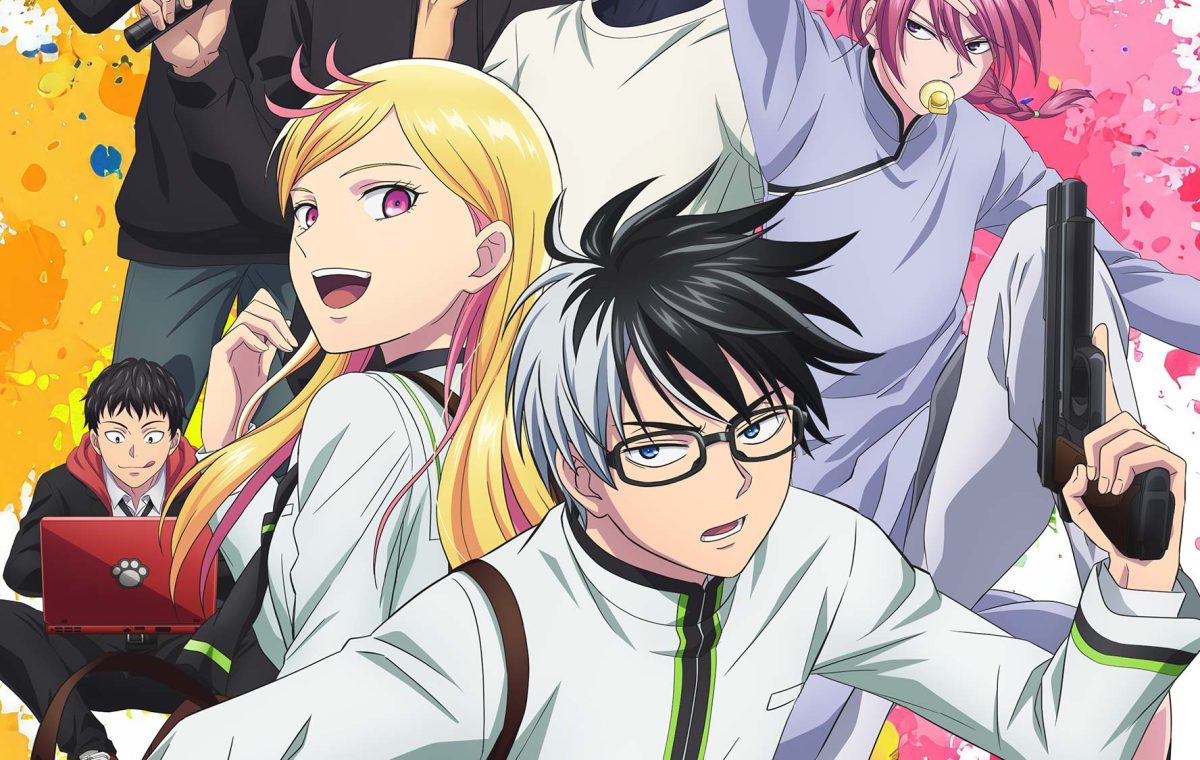
Jūzō Ōgami is a 39-year-old hitman employed by the secret organization Z.O.O. After being stung by a mysterious wasp created through pharmaceutical research, he wakes up physically transformed into a 13-year-old boy. His employer responds to this impossible situation by ordering him to infiltrate Rikka Middle School, where he may find information capable of restoring his adult body.
The resulting 12-episode season combines assassination plots, school comedy, cooking contests, athletic challenges and an increasingly strange collection of professional killers posing as students.
It is rarely as stylish or exciting as the strongest modern action anime, and some of its romantic comedy creates an uncomfortable problem that the series cannot completely avoid. Yet KILL BLUE succeeds because it understands that Jūzō’s transformation is not merely a physical inconvenience.
It gives a man whose childhood was taken from him an unexpected opportunity to imagine a different life.
Jūzō Is More Interesting as a Student Than as an Assassin
The central joke is simple: Jūzō looks like a young teenager but continues speaking, thinking and behaving like a tired middle-aged man.
He is confused by modern school culture, lacks knowledge that most children are expected to possess and frequently reacts to teenage drama with the exhaustion of someone who has already experienced marriage, divorce and professional employment.
Yūko Sanpei’s performance makes that contradiction believable. Her version of Jūzō does not sound like an ordinary child pretending to be mature. His speech carries the blunt confidence and old-fashioned reactions of a man who has spent decades surviving dangerous assignments.
Shunsuke Takeuchi voices Jūzō’s adult form, but Sanpei carries almost the entire season after the transformation. The official cast also includes Fūka Izumi as Noren, Shūichirō Umeda as Kotatsu and several additional actors introduced as the school’s population becomes increasingly chaotic.
The comedy would become repetitive if Jūzō remained nothing more than an adult trapped in an embarrassing body. What gives the premise emotional value is his growing interest in education.
Jūzō was taken into the assassin world when he was young. He never received the ordinary academic or social experiences that his new classmates treat as normal. Returning to school therefore exposes an absence he had stopped recognizing.
He discovers satisfaction in understanding a lesson, completing practical work and receiving sincere praise for something unrelated to killing.
His new body initially appears to be a curse. By the finale, it has become the first event in years that allows him to ask whether being an assassin is truly the only future available to him.
School Life Becomes the Series’ Real Attraction
The assassination plot provides the initial objective, but the season’s strongest material comes from Rikka Middle School.
Jūzō joins the Home Economics Club, learns about cooking and gradually forms relationships with students who know nothing about his real identity. The club gives him responsibilities that cannot be solved with perfect marksmanship.
Preparing food requires patience. Working with classmates requires compromise. Protecting someone during a mission may be simple for him, but explaining his feelings or accepting help is considerably more difficult.
Chisato Shiraishi, the club’s dependable third-year leader, becomes particularly important. The official character profile describes her as a mature student who is affectionately treated as the group’s older-sister figure.
Chisato never needs to understand Jūzō’s entire secret to recognize that something about him is unusual. Her calm support helps turn the club into one of the few places where he can temporarily stop thinking like a professional killer.
Their conversation near the end of Episode 12 gives the season its clearest emotional conclusion. After a chaotic parent-teacher conference, Jūzō begins considering that he might choose a different profession after returning to his adult body.
That realization matters more than defeating another assassin.
The season begins with Jūzō treating school as an assignment. It ends with him seeing education as a route toward a life he never believed he could have.
Noren Is Far More Than a Mission Objective
Noren Mitsuoka initially appears to be the key to Jūzō’s transformation.
She is the daughter of the president of Mitsuoka Pharmaceuticals, the company connected to the wasp that changed him. She is also an outstanding student and athlete who works at her uncle’s ramen shop. Because her family may possess information about the biological weapon, Jūzō deliberately begins spending time around her.
The relationship gradually becomes genuine.
Noren is confident, practical and unwilling to remain a passive target. When assassins threaten her, she does not exist solely to give Jūzō someone to rescue. She challenges him, criticizes his behavior and frequently proves more capable than the classmates surrounding her.
Fūka Izumi gives the character enough directness to prevent her from becoming a standard romantic heroine. Noren’s best exchanges with Jūzō are built around mutual irritation, food and their shared inability to behave like a conventional teenage couple.
Their dynamic also creates the series’ largest problem.
The Romantic Comedy Is Difficult to Ignore
Jūzō may physically resemble a 13-year-old, but he remains a 39-year-old divorced man and father.
That fact makes any romantic interest from his middle school classmates inherently uncomfortable.
The series recognizes the issue to a certain extent. Jūzō does not emotionally behave like a boy experiencing his first romance, and he repeatedly shows little interest in genuinely dating the girls around him. In the finale, he tells Mai that he is not planning to pursue a romantic relationship despite the unusual circumstances connecting him and Noren.
Nevertheless, the anime continues to use attraction toward him as a recurring joke.
Noren’s relationship with Jūzō is presented through an artificial engagement and duel system. Mai Otohime arrives near the end of the season and declares that she wants Jūzō as her boyfriend. The story then begins positioning the girls as romantic rivals while Jūzō reacts like a middle-aged man who wants no involvement in the situation.
His rejection of the premise makes the scenes less troubling than they could have been, but it does not remove the underlying imbalance.
Noren and Mai believe they are interacting with someone their own age. Jūzō possesses decades of adult experience and deliberately conceals his identity from them.
The anime is safest when Noren and Jūzō function as argumentative partners rather than a potential couple. Their chemistry does not require romance, and the story would be stronger if it allowed their friendship and mutual trust to remain the focus.
Kotatsu Is the Support System Jūzō Needs
Kotatsu Nekota is Jūzō’s partner inside Z.O.O. and monitors his undercover work through specialized glasses and an earpiece. He also cooks, cleans and handles many of the practical problems created by Jūzō’s transformation.
In another action series, Kotatsu might have remained the remote operator who delivers information during missions.
Here, he becomes something closer to an exhausted caretaker.
His relationship with Jūzō produces some of the season’s most dependable comedy. The supposedly legendary assassin can defeat armed enemies but often requires Kotatsu to guide him through school systems or prepare his meals.
Episode 12 takes their dynamic to its most absurd conclusion when Jūzō needs an adult for his parent-teacher conference. Kotatsu’s solution is to arrive disguised as Jūzō’s mother, fooling almost no one and generating increasingly confused reactions from the school staff.
The disguise is funny, but the situation also demonstrates how thoroughly Kotatsu supports him. He is not merely completing an assignment. He has built his daily life around making sure Jūzō can survive both assassination attempts and ordinary adolescence.
The Supporting Cast Keeps Expanding
The series becomes increasingly ridiculous as more killers and exceptional students arrive at Rikka Middle School.
Shin Kohazame is an assassin sent by the Chinese organization Yugang to target Noren. Despite his dangerous profession, he becomes unable to communicate properly when separated from his pacifier. His strange devotion to Noren eventually becomes deliberately creepy, and she directly confronts him when his attempts to “protect” her cross personal boundaries.
Tenma Tendo belongs to the school’s elite Unicorn group and excels in soccer, basketball and baseball. His exaggerated athletic confidence allows the anime to move temporarily from assassination comedy into sports parody.
Kazuma and Eiji Rindō bring the professional assassin world back into the school. Kazuma specializes in hypnosis, while Eiji uses extraordinary physical power and attacks through golf. Their methods are intentionally excessive, giving Jūzō enemies who are dangerous without forcing the series to abandon its playful tone.
By Episode 11, so many killers have enrolled that Jūzō organizes a rooftop “hitman summit” and asks them to coexist peacefully. The absurdity works because the anime stops pretending that Rikka is an ordinary school. It becomes a meeting place where criminal organizations, athletic prodigies and cooking-club members somehow share the same classrooms.
Not every supporting character receives enough development. The season introduces new personalities faster than it can explore them, particularly during its final episodes. Mai appears so late that the finale can establish her unusual two-personality transformation and interest in Jūzō but cannot provide much emotional context.
Season 2 will need to give these additions more purpose than simply making Jūzō’s life louder.
The Comedy Is Stronger Than the Action
KILL BLUE is advertised as an action comedy, but viewers seeking a consistently intense assassin story may be disappointed.
The action is occasional rather than dominant.
Jūzō’s abilities allow the anime to create inventive confrontations involving guns, sports equipment, hypnosis and improvised environments. His adult experience inside a smaller body also changes how he moves and forces him to adapt techniques that once depended on his original strength.
The best fights succeed through unusual ideas rather than technical animation.
Studio CUE delivers clear staging and expressive character reactions, but the production rarely reaches the visual intensity of major action-focused titles. Movement can become limited outside important moments, and some confrontations end before they develop into sustained battles.
That limitation fits the source material’s intended tone. Original creator Tadatoshi Fujimaki described KILL BLUE as something deliberately light and easy to enjoy rather than a story built around constant extraordinary events.
The anime is consequently more successful during a ramen competition than a gunfight.
One of the funniest later sequences has Noren and Shin becoming so competitive that their attempts to prepare ramen turn into impractical culinary weapons. The episode allows the characters’ excessive personalities to create the joke naturally instead of relying only on Jūzō’s age reversal.
The Character Animation Carries the Presentation
The visual production is not consistently ambitious, but it understands the importance of facial comedy.
Jūzō’s expressions shift between the face of an irritated child and the exhausted stare of a man who has been working for decades. Noren’s confidence collapses whenever events become too ridiculous, while Kotatsu’s panic frequently provides a second reaction to Jūzō’s decisions.
Miho Daidoji’s character designs retain the manga’s broad expressions and make the cast easy to distinguish even as the school becomes increasingly crowded. The official production credits list Hiro Kaburagi for animation supervision and scripts, Yasunori Ide for animation direction, Ryo Konishi for music and CUE for animation production.
Backgrounds and action cuts can look modest, but the series generally preserves its personality. It knows that a carefully timed blank stare can be more important to its comedy than elaborate movement.
The soundtrack follows the same philosophy. It supports the contrast between criminal danger and ordinary school life without making either side feel as though it belongs to a different show.
aespa performs the opening theme “ATTITUDE,” while RIIZE performs the rock-influenced ending song “KILL SHOT.” Both tracks were chosen to reflect the series’ fast energy and the intersection between its ordinary and extraordinary sides.
The Season Lacks a Complete Narrative Destination
The first season often feels like the opening portion of a much longer adaptation rather than a self-contained story.
Jūzō does not regain his adult body. The full purpose of the mysterious wasp remains unresolved, and the conflict involving Mitsuoka Pharmaceuticals continues in the background. New assassins are introduced faster than existing questions are answered.
Episode 12 is particularly unusual as a finale.
Mai challenges Jūzō and Noren to a surfing competition, prompting the Home Economics Club to organize beach training. The episode then postpones that storyline and spends most of its remaining time on parent-teacher conferences and Jūzō’s thoughts about his future.
Emotionally, the decision works. Jūzō’s realization provides a more meaningful endpoint than another fight.
Structurally, however, the season ends in the middle of a new storyline.
A second season was officially announced immediately after the finale aired on June 27, 2026, although no premiere window was included. Season 1 consisted of 12 episodes and began on April 11.
The renewal explains the unfinished setup, but viewers should not expect the first season to resolve its central mystery.
Its Greatest Idea Is a Life Beyond Violence
The assassination material supplies danger, but the show’s most valuable idea is that Jūzō may not need to return to his old life unchanged.
At first, his objective is simple: investigate the school, learn the truth about the wasp and restore his adult body.
The season gradually separates returning to adulthood from returning to the same identity.
Jūzō can become 39 again without becoming only a killer. His school experiences show him that intelligence, patience and leadership can be used in other ways. Cooking, studying and helping his classmates do not erase his violent history, but they provide evidence that he possesses value beyond his ability to eliminate targets.
This is where KILL BLUE becomes more than its initial joke.
The anime does not pretend that a second childhood can repair everything. Jūzō remains separated from his daughter, trapped inside a false identity and surrounded by organizations willing to use children as part of their conflicts.
Yet the transformation gives him time to reconsider choices that once felt permanent.
The body he wants to escape may be the reason he finally begins living for himself.
Final Verdict
KILL BLUE is an entertaining but uneven action comedy whose school-life material consistently outperforms its assassin storyline.
Jūzō is an excellent central character. His middle-aged personality produces reliable comedy, while his growing love of education gives the season an unexpectedly sincere emotional foundation. Yūko Sanpei’s performance successfully connects his childish appearance with the adult life hidden beneath it.
Noren, Kotatsu, Chisato and the expanding collection of eccentric classmates give the anime warmth. The Home Economics Club scenes are particularly effective because they allow Jūzō to experience cooperation without treating every interaction as a mission.
The series is less successful when it attempts to turn his relationships with middle school girls into romantic comedy. Jūzō’s lack of interest prevents the material from becoming completely irresponsible, but the age and experience imbalance remains impossible to overlook.
Its action is creative but not visually exceptional, its supporting cast becomes overcrowded and the first season ends before resolving either the wasp mystery or its latest challenge.
Even so, KILL BLUE is difficult to dislike.
It is light without being empty, ridiculous without completely abandoning emotional sincerity and surprisingly thoughtful about the difference between returning to one’s old body and returning to one’s old life.
Jūzō begins the series searching for a cure.
By the finale, he has discovered something more important: a reason to ask what he wants to become after he is cured.
Rating: 7.5/10
KILL BLUE Season 1 contains 12 episodes. The official international site lists availability through services including Netflix, Crunchyroll and Prime Video, with platform coverage varying by region.



Comments
Share your opinion and keep the conversation respectful.