
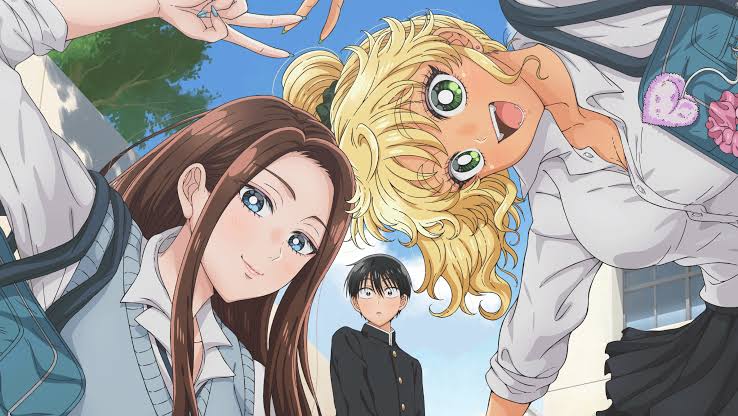

At first glance, Gals Can’t Be Kind to Otaku!? appears to be assembled from familiar romantic-comedy ingredients.
Takuya Seo is a quiet high school student who hides his love for GlitterMon, a colorful anime aimed primarily at younger girls. Sitting near him are two popular gals who seem to belong to an entirely different social world: the cheerful and outgoing Kotoko Ijichi and the cool, difficult-to-read Kei Amane.
The expected fantasy is obvious. An isolated otaku attracts the attention of two beautiful classmates and somehow finds himself at the center of a romantic competition.
The anime does follow part of that formula. Both girls gradually develop feelings for Takuya, and he remains painfully slow to recognize what is happening. What prevents the series from becoming another empty wish-fulfillment comedy is the sincerity of the relationship connecting all three characters.
Kotoko and Kei are not rewards waiting for Takuya to choose between them. They are best friends with their own insecurities, responsibilities and emotional needs. Takuya is not valuable because the story insists that he deserves attractive girlfriends. He becomes important to them because he listens, speaks honestly and gives both girls a place where they can stop performing for other people.
The season consequently works less as a race toward a confession and more as a story about three teenagers building a space in which each of them can be comfortable.
Anime Brings Three Different Worlds Together
Takuya’s interest in GlitterMon is more than a convenient plot device.
He loves the series but expects that openly discussing it will invite ridicule. His embarrassment reflects a wider fear that his hobbies automatically place him beneath more socially successful classmates.
That assumption begins to collapse when a conversation reveals that Kei knows considerably more about GlitterMon than she is willing to admit. Kotoko does not share the same knowledge, but rather than mocking either of them, she becomes curious and joins their conversations.
The trio’s relationship grows naturally from that small discovery. They watch anime at Takuya’s home, go out together, visit karaoke, spend time at the beach and eventually prepare for their class’s school-festival activities. The official episode summaries show the series gradually moving from their first shared conversations into increasingly personal situations, including separate invitations, a summer festival, a sleepover and the culture festival that closes the season.
These activities are conventional for a school romantic comedy, but the anime uses them to show how comfort develops.
Takuya no longer needs to carefully hide every enthusiastic reaction. Kei gains someone with whom she can discuss her interests without pretending the knowledge belongs to somebody else. Kotoko discovers that entering another person’s hobby does not require her to become an expert first.
The show understands something simple but important: sharing a passion is not only about liking the same object. It is also about feeling safe enough to show another person why it matters to you.
Takuya Is Awkward Without Being Insufferable
Takuya belongs to a familiar category of romantic-comedy protagonist: shy, inexperienced and unable to imagine that either girl might be interested in him.
The character could easily become frustrating. He misses obvious signals, panics whenever Kotoko or Kei gets close and often interprets emotional moments as ordinary friendship.
His obliviousness works better than expected because it is connected to his lack of social experience rather than simple stupidity.
Takuya does not begin the season believing he deserves either girl. In fact, he struggles to believe that he belongs beside them at all. He views Kotoko and Kei as people from a brighter social world and treats their friendship as something fragile that could disappear as soon as they recognize how different he is.
That insecurity becomes especially important during the school-festival finale. As the two girls receive public attention, Takuya begins to feel that the distance between them has returned. His discomfort is not merely romantic jealousy; it is the fear that the first genuine friendships of his school life were temporary.
The official summaries for Episodes 11 and 12 describe his growing, unexplained feelings toward the girls and his reaction when they stand in the festival spotlight.
This gives the finale more emotional weight than a standard “which girl will he choose?” conflict. Before Takuya can understand romance, he must accept that Kotoko and Kei actively want him in their lives.
Kei Amane Is More Than the Cool Hidden Otaku
Kei initially appears to be the quieter and more controlled member of the pair.
She maintains a composed image at school and hesitates to admit how deeply invested she is in GlitterMon. Her attempts to conceal her interests are rarely convincing, especially once Takuya recognizes the speed and precision with which she corrects information about the series.
The humor comes from the gap between the person Kei wants others to see and the person who emerges whenever her favorite anime is mentioned.
She can look mature and distant one moment, then become intensely competitive or embarrassingly enthusiastic the next. The anime does not treat that side of her as a secret personality that invalidates her usual behavior. Both versions are genuinely Kei.
Her connection with Takuya is the most immediately obvious because they share the same fandom. He understands references without explanation, notices her concealed excitement and gives her permission to speak openly.
Yet the series avoids implying that shared interests automatically make them the correct couple.
Kei’s friendship with Kotoko remains equally important. She does not want romantic progress if it requires hurting or excluding the person who has already accepted her for years. That loyalty prevents the triangle from turning into a collection of cheap jealous confrontations.
Kotoko Ijichi Gives the Series Its Warmth
Kotoko is the character who initially seems closest to the familiar gal stereotype.
She is energetic, physically affectionate and comfortable speaking to almost anyone. She quickly invades Takuya’s personal space, proposes group activities and pulls the quieter characters into situations they would never initiate themselves.
The season gradually reveals that her openness requires effort.
Kotoko helps care for her younger siblings and presents a less polished version of herself at home. She understands social situations more quickly than Takuya or Kei, but that awareness also means she notices whenever the other two appear to be growing closer without her.
Her jealousy is handled with unusual gentleness.
She does not sabotage Kei or turn their friendship into a battlefield. When she feels left behind, she looks for more opportunities to spend time with Takuya while continuing to support Kei. Her sadness comes from fearing the loss of her place within the trio, not from believing she owns either person.
That distinction makes her extremely easy to support.
Kotoko also becomes the bridge between the two otaku characters. She may not begin with their knowledge, but she approaches their interests without judgment and learns enough to participate. She proves the title wrong almost immediately: a gal can absolutely be kind to an otaku, not because she is romantically interested in him, but because curiosity and empathy are normal human qualities.
The Rare Triangle Where Both Girls Strengthen Each Other
Many love-triangle stories depend on imbalance.
One heroine receives most of the emotional development, while the other exists to delay the inevitable relationship. Alternatively, the girls become rivals whose friendship disappears whenever the male lead enters the room.
Gals Can’t Be Kind to Otaku!? refuses both approaches.
Kei and Kotoko have chemistry independent of Takuya. They tease each other, understand each other’s weaknesses and repeatedly protect the friendship they had before he joined them.
Takuya does not break their existing connection. He becomes part of it.
That is why choosing a single “winner” feels unusually difficult. A conventional conclusion in which one girl dates Takuya while the other quietly withdraws could damage the quality that makes the series special. The emotional appeal comes from the three-way balance: Kei shares Takuya’s passion, Kotoko gives the group momentum, and Takuya offers both girls unfiltered acceptance.
The show is strongest when none of them is being treated as an obstacle.
Even the romantic tension is expressed through a desire for closeness rather than ownership. Kotoko and Kei sometimes compete for Takuya’s time, but they continue to care about each other’s happiness. The possibility of an unconventional conclusion feels more emotionally honest here than forcing the story to select one relationship and weaken the other two.
Romance Develops Slowly—and That Is Both a Strength and a Weakness
The first season spends more time establishing friendship than delivering decisive romantic progress.
Kotoko and Kei begin recognizing their feelings, particularly during the summer and school-festival portions of the story. Takuya, however, remains several steps behind them.
This pacing suits his character. A boy still learning to believe that he has real friends would not immediately interpret their affection as romantic desire.
The problem is that the season can occasionally feel repetitive.
A typical sequence places the trio in a new activity, allows one or both girls to create an intimate moment and concludes with Takuya misunderstanding its meaning. His exaggerated reactions remain funny, but the same emotional rhythm appears often enough that viewers looking for a confession may become impatient.
The anime also relies on familiar situations: a visit to the protagonist’s room, casual dates, swimsuits, karaoke, a summer festival, an overnight stay and a cosplay café.
The execution is warm, but the scenarios themselves rarely surprise.
What keeps the season moving is not the question of whether one of the girls will create another romantic misunderstanding. It is the gradual change in how the three characters define their relationship.
By the finale, Takuya still cannot properly name his feelings, but he can no longer pretend that Kotoko and Kei are ordinary classmates.
Kindness Replaces Manufactured Drama
The series’ most refreshing quality is its refusal to create conflict through cruelty.
There is no villainous classmate attempting to expose Takuya’s hobbies. Kei is not humiliated for liking an anime aimed at girls. Kotoko does not suddenly become hostile because her best friend shares something special with him.
Misunderstandings occur, but the characters generally resolve them by talking or by paying attention to one another.
This does not mean the world is completely realistic. The story is highly idealized, and Takuya’s rapid friendship with two of the most popular girls in class remains an obvious fantasy.
The fantasy is simply more compassionate than usual.
Its central promise is not that every lonely otaku will attract two beautiful gals. It is that people who appear socially incompatible may discover common ground once they stop judging one another from a distance.
The official production staff repeatedly described the original work as a story built around gentleness and consideration, and that philosophy is visible throughout the adaptation. The anime was directed by Shin Mita, with series composition by Kazuhiko Inukai and animation production by TMS Entertainment’s Studio 6.
The Visual Presentation Is Bright but Not Always Consistent
The anime’s character designs successfully preserve the appeal of Sakana Uozumi’s manga art.
Kotoko and Kei are visually distinctive without looking as though they belong in separate shows. Their gal fashion communicates personality: Kotoko appears more openly energetic, while Kei’s cooler presentation supports the image she tries to maintain.
Facial expressions do much of the comedic work.
Takuya’s reactions can become absurdly exaggerated, while Kei’s mask collapses whenever her otaku enthusiasm takes over. Kotoko is more physically expressive, often transforming otherwise ordinary conversations through movement and proximity.
The animation itself is functional rather than luxurious. Important close-ups and comedic reactions receive attention, but quieter scenes sometimes rely on limited movement and uncomplicated staging.
That limitation rarely damages the series because it is driven primarily by dialogue and character chemistry. Still, viewers expecting the visual polish of the strongest contemporary romance productions may find it modest.
The direction is most successful when it emphasizes contrasts: the polished image of the girls against their chaotic private behavior, or the bright festival environment against Takuya’s isolating thoughts.
The Voice Cast Makes the Trio Believable
The principal performances carry much of the anime’s warmth.
Shō Komura voices Takuya, while Konomi Inagaki plays Kei and Yū Serizawa plays Kotoko. The official cast also includes Jun Kasama, Konomi Kohara, Atsumi Tanezaki and Emiri Katō in supporting roles.
Komura captures the speed and intensity of Takuya’s fandom without making every reaction sound identical. His voice changes naturally when Takuya moves from guarded conversation into enthusiastic discussion.
Inagaki gives Kei the necessary duality. Her controlled school voice and excited otaku delivery feel connected rather than like two unrelated performances.
Serizawa provides the broadest energy, but Kotoko never becomes merely loud. Her performance makes the character’s quieter insecurity believable, particularly when she senses a change in the group dynamic.
Together, the three actors sell the friendship before the romance. That is essential because the series would collapse if their time together felt like nothing more than a scripted harem arrangement.
The Finale Understands the Season’s Real Conflict
The last episodes use the school festival to bring Takuya’s insecurity to the surface.
Kei and Kotoko participate in the class’s cosplay café and receive attention during the festival. Watching them stand confidently in front of other students causes Takuya’s vague discomfort to grow.
He begins retreating because he sees their popularity as evidence that he never truly belonged beside them.
The resolution does not depend on either girl delivering a direct romantic confession. Instead, they make it clear that their relationship with him is not accidental or temporary.
That is the correct conclusion for this stage of the story.
The season begins with Takuya assuming that people such as Kotoko and Kei could never understand him. It ends with him finally recognizing that both girls have repeatedly chosen to remain close.
The romance is still developing, but the emotional foundation is secure.
Final Verdict
Gals Can’t Be Kind to Otaku!? does not reinvent the school romantic comedy.
It uses a shy otaku protagonist, two attractive classmates, accidental intimacy, seasonal events and an unresolved love triangle. Its animation is not consistently remarkable, and viewers expecting rapid romantic progress may find Takuya’s emotional development slow.
What distinguishes the series is the care given to all three central relationships.
Takuya and Kei connect through a passion neither can comfortably discuss with everyone. Takuya and Kotoko grow closer because she refuses to treat his awkwardness as a reason to dismiss him. Kei and Kotoko preserve a friendship that remains valuable regardless of which one develops stronger romantic feelings.
The anime never needs to make one girl worse to make the other more appealing.
That balance transforms an ordinary premise into an unusually comforting series about acceptance. The real fantasy is not that two gals fall for an otaku. It is that three people can meet without demanding that any of them hide the parts of themselves they assume others will reject.
A future season will eventually need to move the romance forward. Takuya cannot remain oblivious forever, and the story must decide what kind of relationship these three characters are building.
For its first 12 episodes, however, friendship is enough.
Gals Can’t Be Kind to Otaku!? is a familiar but exceptionally warm romantic comedy whose strongest possible ending may be the one that refuses to separate its central trio.
Rating: 8.5/10
The anime premiered in Japan on April 8, 2026, ran for 12 episodes and is available internationally through Crunchyroll. The original manga is written by Norishirochan, illustrated by Sakana Uozumi and published in English by Yen Press.




Comments
Share your opinion and keep the conversation respectful.