
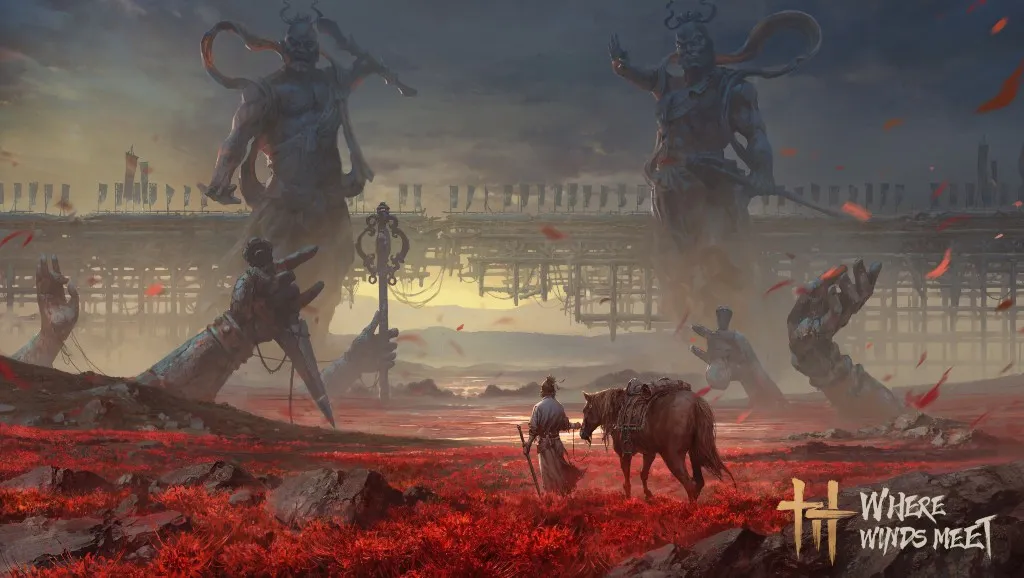

Where Winds Meet entered the global market with an unusually ambitious promise: combine a cinematic single-player action RPG, a large online world, cooperative dungeons, competitive modes and the freedom of classic wuxia fiction inside one free-to-play game.
That ambition has produced an experience that can be breathtaking, confusing, rewarding and exhausting—sometimes within the same hour.
Developed by Everstone Studio and published by NetEase Games, the game places players in tenth-century China during the Five Dynasties and Ten Kingdoms period. Its global version originally launched for PC and PlayStation 5 in November 2025, followed by mobile devices in December. Xbox Series X|S, Xbox on PC and Xbox Cloud Gaming joined the supported platforms in June 2026.
The game has also changed significantly since release. Version 2.0 arrived in July 2026 with the Hidden Mountain region, new bosses, additional exploration systems and broader improvements to combat and presentation. This makes 2026 a stronger time to begin than launch week—but the game’s enormous number of menus, progression systems and activities can still overwhelm an unprepared newcomer.
Why Where Winds Meet Is Worth Playing in 2026
Its Wuxia World Feels Different From Most Open-World RPGs
The game’s greatest strength is its setting.
Instead of another medieval European fantasy world, Where Winds Meet draws from wuxia—the Chinese tradition of wandering martial artists, rival schools, personal codes of honor and warriors capable of seemingly impossible physical feats.
Players travel through cities, villages, forests, ruins, underground chambers and mountainous landscapes while becoming involved with political factions and martial sects. The world blends historical influences with supernatural techniques, allowing the protagonist to run across walls, leap through the air and use abilities such as Tai Chi alongside more conventional sword fighting.
Its visual identity is one of its most immediate attractions. Bamboo forests, crowded streets, mountain temples and rivers covered in mist give each journey a sense of place. Weather, changing light and environmental detail frequently turn ordinary travel into something worth slowing down to appreciate.
The game is particularly appealing to players who enjoyed the landscapes of Ghost of Tsushima, the martial-arts fantasy of Chinese cinema or the exploration-focused structure of modern open-world RPGs.
Version 2.0 Gives New Players Even More to Explore
The July 2026 Hidden Mountain update substantially expanded the world.
Everstone describes the region as containing four main areas, 14 subregions, more than 10 bosses, eight Jianghu Legacies and dozens of additional side stories. Its landscape has more than 2,000 metres of vertical depth, connecting valleys, underground ruins, mountain paths and a mechanical city built above the clouds.
Hidden Mountain also introduces a stronger focus on ancient Mohist machinery. Players must observe gears, mechanisms and environmental clues to open routes and uncover hidden chambers rather than simply following objective markers.
This vertical design gives the newer region a more layered structure than many of the earlier zones. Exploration can move above, below and through the same location, making the map feel less like a flat collection of icons.
Newcomers do not need to rush directly toward Version 2.0 content, but its existence shows that the game is still receiving substantial expansions rather than only small seasonal events.
The Combat Is Stylish but Still Rewards Skill
Where Winds Meet is visually spectacular, but its combat is not based entirely on flashy animations.
Successful play requires an understanding of dodging, blocking, deflection timing, weapon switching and enemy attack signals. Powerful opponents can punish random button pressing, particularly on higher difficulty settings.
Deflecting at the correct moment damages an opponent’s defensive resources and creates opportunities for stronger attacks. Some enemy moves cannot be answered with a normal block, while others require repositioning or a carefully timed response.
The result resembles a more accessible mixture of Sekiro-style parries and a traditional character-action system. Reviews have consistently identified combat as one of the game’s strongest elements, particularly during optional boss battles and major cinematic encounters.
The difficulty is also adjustable. Players more interested in exploration and story can use the available assistance options, while those seeking a harsher challenge can reduce the game’s defensive help and face bosses under stricter conditions.
That flexibility allows Where Winds Meet to appeal to more than one type of action-RPG player.
Weapons Feel Meaningfully Different
The game allows players to build a fighting style around both traditional and unusual weapons.
Swords, dual blades, spears and heavier weapons are joined by fans, rope darts and combat umbrellas. These are not simply cosmetic alternatives. Their martial arts provide different attack ranges, defensive options and team roles.
An umbrella may support ranged pressure or defensive abilities, while a fan can contribute healing and support. Other paths are designed around aggression, control or stronger close-range damage.
Players can equip two weapons and switch between them during combat, creating combinations that cover each other’s weaknesses. The system gives experimentation real value without requiring the player to create a new character for every build.
The game also includes more than 30 Mystic Arts, which can provide combat attacks, movement abilities or unusual interactions with the environment.
This freedom is one of the main reasons to keep playing after the opening hours. Discovering a new weapon path can change the rhythm of combat enough to make older activities feel fresh again.
It Offers a Substantial Single-Player Experience
Despite its online systems, Where Winds Meet can be approached primarily as a solo action RPG.
The PlayStation listing promotes more than 150 hours of single-player material, including the main campaign, optional stories, exploration objectives and boss encounters. Players can spend long periods inside Solo Mode without needing to join a guild or participate in competitive content.
This separation is valuable for people who enjoy large RPGs but do not want strangers constantly interrupting their world.
The online elements remain available when needed. Players can invite friends, explore together, tackle cooperative dungeons, join guild activities or enter PvP modes. Later updates also expanded the number of exploration rewards and activities that can be completed cooperatively.
The game therefore works best when treated as a single-player adventure with optional MMO features—not as an MMO that demands permanent group participation.
The Free-to-Play Model Does Not Sell Combat Power
Free-to-play action RPGs often create immediate concern about pay-to-win mechanics. Where Winds Meet currently avoids selling direct character strength.
Its official mobile listings state that gameplay content is free and that monetisation is limited to cosmetics. Paid offerings include outfits, mounts, weapon appearances, visual effects, monthly passes and cosmetic draws rather than stronger weapons or character levels.
This does not mean the shop is invisible. Premium outfits, battle-pass menus and random cosmetic rewards are still promoted inside the game. Players vulnerable to collection pressure may find those systems distracting.
However, spending is not required to complete the story, defeat bosses or maintain competitive combat statistics. A player’s effectiveness is determined by progression, equipment choices and execution rather than the price of an outfit.
For such a large free game, that remains an important advantage.
Cross-Play and Cross-Progression Are Excellent
By mid-2026, the game is available across PC, PlayStation 5, Xbox Series X|S and mobile devices.
Character progress can be shared across supported platforms, and Xbox users can play online with people on PC, PlayStation and mobile. Characters, items, martial arts, purchases and general progression are connected through the same properly linked account.
This is especially useful for a long-term open-world game. A player can use a PC or console for major story missions and then continue with smaller activities on a mobile device.
There is an important account-linking warning, however: existing accounts should be linked before creating a character on a new platform. Two accounts that already contain separate characters generally cannot be merged afterward.
The Weaknesses of Where Winds Meet
The Game Tries to Include Too Many Systems
Where Winds Meet contains an extraordinary number of ideas.
Beyond story quests and combat, players encounter crafting, fishing, healing, illnesses, debates, stealth sections, puzzles, sect rules, guilds, cooperative dungeons, PvP, minigames, social activities and several layers of character progression.
Variety is enjoyable, but the game does not always introduce these elements cleanly.
New menus, currencies and upgrade materials appear rapidly during the opening hours. Important character-development systems can become buried beneath notifications and limited-time activities. Reviews have frequently criticised the interface and the excessive number of overlapping mechanics.
Not every feature has the depth of the combat or world exploration. Some feel like brief experiments added because the developers were reluctant to reject any idea.
The best response is not to attempt everything immediately. Most optional systems can be ignored until the player has a clear understanding of their preferred weapons and core progression.
The Interface Is Often More Difficult Than the Enemies
The user interface remains one of the game’s weakest areas.
Menus contain numerous tabs, reward notifications, progression trackers and event icons. Finding a particular upgrade item or understanding which system produced it can require more effort than expected.
Everstone has gradually improved this problem. Updates have added search functions, path tutorials, clearer item information and other interface adjustments. The May 2026 update introduced dedicated practice stages for different combat paths to lower the learning curve.
Even with those changes, the game still feels designed around long-term live-service engagement. Players who prefer clean, minimalist single-player menus may find its presentation unnecessarily busy.
Storytelling and Localization Can Be Uneven
The broader world and historical atmosphere are compelling, but individual conversations do not always reach the same standard.
Some quests deliver emotional character stories and memorable cinematic scenes. Others rely on lengthy explanations, sudden tonal shifts or characters who appear before the player fully understands their role.
English localization and voice presentation were criticised around the global launch. The developers later acknowledged those concerns and said they had revised translations, subtitles and dubbing to make conversations more natural.
The experience has improved, but occasional awkward wording and inconsistent delivery remain possible in a game containing this much dialogue.
Playing with the original Chinese voices can provide a more consistent performance, although this requires reading subtitles throughout story scenes.
Its Scale Can Become Exhausting
Large maps are an advantage only while the player remains interested in exploring them.
Where Winds Meet fills its world with puzzles, chests, bosses, side stories and short activities. The density creates frequent discovery, but completion-focused players may begin treating each region like a checklist.
Trying to clear every icon before advancing the main story can quickly produce fatigue. The game is better when exploration happens naturally between quests rather than becoming compulsory map cleaning.
The same problem affects live-service objectives. Daily and weekly activities can make players feel as though they are falling behind, even when the permanent campaign is not going anywhere.
There is no need to complete everything. Ignoring activities that do not support your preferred build is often the healthiest way to play.
PC Storage and Hardware Requirements Are Significant
The game is visually impressive, but the PC version can be demanding.
Steam currently recommends 32 GB of RAM, an RTX 2070 Super or equivalent graphics card, and 200 GB of available storage. It also recommends installation on an SSD.
The official launcher guide lists different storage requirements depending on installation configuration, so the necessary space may vary between clients and downloaded content packages.
Players should leave additional free space for updates rather than installing the game when a drive is nearly full. Large Version 2.0-style expansions can increase temporary installation requirements during patching.
PC users should also test performance before purchasing cosmetic items. A free game is still a poor investment of time when the chosen system cannot maintain an acceptable frame rate in cities or large battles.
Online Play Depends on Region and Connection Quality
Cross-play is a major strength, but server selection matters.
Cross-progression and multiplayer operate within the same server region, and character data cannot currently be transferred freely between regional servers.
The developers have also acknowledged higher latency reports in some regions. When players from different areas form a PvP party, matchmaking follows the party leader’s chosen server, which can produce a worse connection for other members.
Players should therefore choose their original region carefully, especially when planning to join friends. Selecting the geographically closest server is not enough when the rest of the group plays elsewhere.
What New Players Should Pay Attention to
Begin With Solo Mode
The large number of online menus may create the impression that guilds and multiplayer activities must be entered immediately. They do not.
Complete the opening story, learn the combat system and unlock several weapon paths before becoming deeply involved in online modes. Solo progression provides enough structure to understand the world without adding matchmaking and guild obligations.
Friends can still be invited when a boss or exploration objective would be more enjoyable cooperatively.
Do Not Upgrade Every Weapon
The game encourages experimentation, but resources should not be spread equally across every martial path.
Test different weapons first. Once two complementary styles feel comfortable, concentrate upgrades on those paths and the Inner Ways that support them.
A close-range weapon combined with a ranged, defensive or healing option usually provides more flexibility than two weapons that perform the same role.
Version 1.7 and Version 2.0 also introduced balance adjustments, meaning an unpopular path can improve in a later update. Choose weapons based on enjoyment and function rather than permanently chasing the current community meta.
Learn Deflection Instead of Avoiding It
Assisted defensive options can make the early game comfortable, but relying on them completely may create problems during harder bosses or PvP.
Spend time learning enemy animations and deflection timing. Dodging remains useful, but successful deflections create offensive opportunities that simple retreating cannot provide.
The game added a recommended Assist Deflection setting that helps against boss and powerful enemy attacks while ignoring ordinary attacks. This can serve as a useful middle ground while learning the system.
Link Accounts Before Starting on Another Platform
This is one of the most important technical warnings.
A player continuing an existing character on Xbox, PlayStation, PC or mobile should link the correct account before creating another character. Once two platform accounts both contain character data, they may no longer be eligible to link.
Read the official linking instructions before moving platforms. Several minutes of preparation can prevent the loss of hundreds of hours of transferable progress.
Pick the Correct Server Region
Server regions affect both multiplayer and character access.
Choose the region where most of your friends play, provided the resulting latency remains acceptable. Characters cannot simply be moved between regions later, and cross-platform functionality does not remove this restriction.
Players primarily interested in solo content should generally select the nearest available region for the most reliable connection.
Treat Cosmetics as Optional
The game does not currently sell combat power, but its appearance system is designed to attract collectors.
Premium costumes, mounts and visual effects can be appealing because character customization is a major part of the game. Cosmetic draws can still become expensive even when they provide no competitive advantage.
Play long enough to understand whether Where Winds Meet will remain part of your routine before purchasing a monthly pass or premium currency.
Free outfits and appearance rewards are also distributed through quests, events and updates. Version 2.0 includes several outfits and pull rewards obtainable through Hidden Mountain content.
Avoid Trying to Finish the Entire Map
The world is too large to approach as a short checklist game.
Follow the main story, investigate side content that looks interesting and return to earlier regions when a new technique makes exploration easier. This creates a more natural rhythm and prevents exhaustion.
Missing a small chest is less damaging than turning a beautiful region into unpaid work.
Who Should Play Where Winds Meet?
The game is easy to recommend to players who enjoy:
- Wuxia stories and Chinese historical fantasy
- Open worlds built around discovery
- Parries, boss battles and flexible action combat
- Experimenting with unusual weapons
- Long free-to-play RPGs
- Optional co-op, guild and PvP content
- Character creation and cosmetic customization
It may be less suitable for players who dislike:
- Busy interfaces and many currencies
- Live-service menus and battle passes
- Large amounts of optional content
- Uneven localization
- Gear and progression systems requiring research
- Always-online games
- Very large PC installations
Final Verdict
Where Winds Meet is worth playing in 2026, particularly because Version 2.0 has expanded the world and improved systems that felt less polished around launch.
Its finest qualities are easy to see. The wuxia setting gives it a strong identity, movement makes exploration enjoyable and its weapon system supports substantially different combat styles. Boss battles can be dramatic and mechanically satisfying, while the free single-player campaign contains more permanent content than many full-price RPGs.
Its weaknesses come from the same ambition.
The game frequently feels overcrowded with menus, currencies, progression paths and side activities. Story presentation is uneven, localization is not always natural and completion-focused players may become exhausted by the sheer number of objectives.
The ideal way to play is selectively.
Treat it as a solo wuxia action RPG first. Learn one or two weapon paths, explore without attempting to clear every marker and enter multiplayer only when it adds something to the experience. Ignore the premium shop unless a cosmetic genuinely matters to you.
Approached with that mindset, Where Winds Meet offers one of the most unusual and generous free open-world adventures available in 2026. It may not be the most focused RPG, but few competitors can match its combination of martial-arts spectacle, historical atmosphere and freedom.





Comments
Share your opinion and keep the conversation respectful.